The Full Story
About Covid 19

COVID-19 (2020)
The first Postpandemic album.
Created during the first months of lockdown, Covid-19 imagines a future looking back on the pandemic as the event that transformed human civilisation. Combining rock, folk, spoken word, satire and theatrical experimentation, the album explores surveillance, ecological collapse, Universal Basic Income, political failure and the possibility of a radically different future.
Viewed today, the album has acquired an unexpected poignancy. The future it anticipated never arrived. Rather than becoming a record of what happened, Covid-19 became a record of what might have happened.

1. The Nightmare Arrives
Songs: They Know Everything, Dead Dodoes
Image Theme: Pandemic anxiety, surveillance, masks, urban unease.
The opening track They Know Everything presents the absurd paranoia and conspiracy fears that flourished during the pandemic. The song is satirical, surreal and darkly comic, exaggerating surveillance anxieties until they become grotesque caricature.
Dead Dodoes then pulls the listener backwards in time. The song reminds us of the ecological and social crises that already existed before Covid arrived. Climate change, consumerism and environmental collapse provide the context from which the pandemic emerges.
Together these tracks create the album's first movement: the world before the plague and the fears unleashed by its arrival.
2. Imagining Another World
Songs: U.B.I., When the Sickness Seeps In
Image Theme: Sustainable futures, automation, utopia contrasted with pandemic imagery.
The album now pivots from diagnosis to possibility.
U.B.I. imagines a future in which automation and abundance free humanity from economic insecurity. The song combines a serious political proposal with playful musical clichés and humour, refusing to become dogmatic.
When the Sickness Seeps In provides the counterweight. The pandemic becomes nature's warning, exposing the fragility of the systems humanity has built. Together the two songs form a debate between catastrophe and transformation.


3. THE UTOPIAN THREAD
Running beneath the album is a persistent utopian impulse.
Songs such as U.B.I., Progress Happens and We Don't Want To Go Back imagine alternatives to existing economic and social structures. The pandemic becomes a lens through which long-standing concerns about work, inequality, technological development and environmental destruction can be reconsidered.
Unlike dystopian narratives, Covid-19 repeatedly asks what might emerge if humanity learned the right lessons from crisis.
4. Protest, Prophecy and Collapse
Songs: No-one's Going To Help You; Oh Children! Why Are You Here?; Covid-19
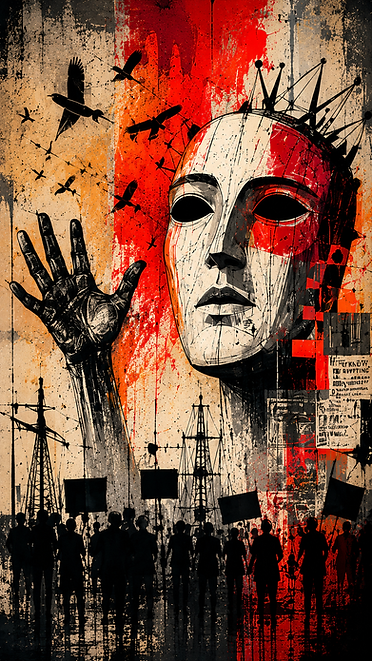
Image Theme: Protest, crowds, plague imagery, classical tragedy.
The centre of the album becomes increasingly theatrical.
No-one's Going To Help You attacks political and economic systems that repeatedly fail ordinary people.
Oh Children! Why Are You Here? draws upon Sophocles' Oedipus Rex, transforming an ancient plague narrative into a modern ecological and social warning.
Covid-19 itself functions as the title statement: the moment when the pandemic becomes both symbol and historical reality.
Together these tracks give the album its prophetic voice.

5. The Manifesto and the Weariness
Songs: Progress Happens; 2020; Tired
Image Theme: Empty roads, political speeches, reflective landscapes.
This section forms the philosophical centre of the album.
Progress Happens offers a playful but sincere vision of human development and freedom.
2020 abandons music entirely and delivers a spoken manifesto cataloguing the absurdities and crises of the contemporary world.
Tired follows as the emotional response. After the arguments, analyses and warnings, exhaustion remains.
This sequence may be the album's most human moment.
6. The Future That Never Arrived
Songs: We Don't Want To Go Back; Wuhan
Image Theme: Future cities, hope, memory, reconstruction.
The final movement looks forward.
We Don't Want To Go Back rejects the return to the pre-pandemic "normal." The song argues that crisis should become an opportunity for reinvention.
Wuhan completes the journey. Written from an imagined future perspective, it assumes that humanity has learned the lessons of the pandemic and entered a better era.
History did not follow that path.
As a result, the album closes not with triumph but with nostalgia for a future that never arrived.


